
|
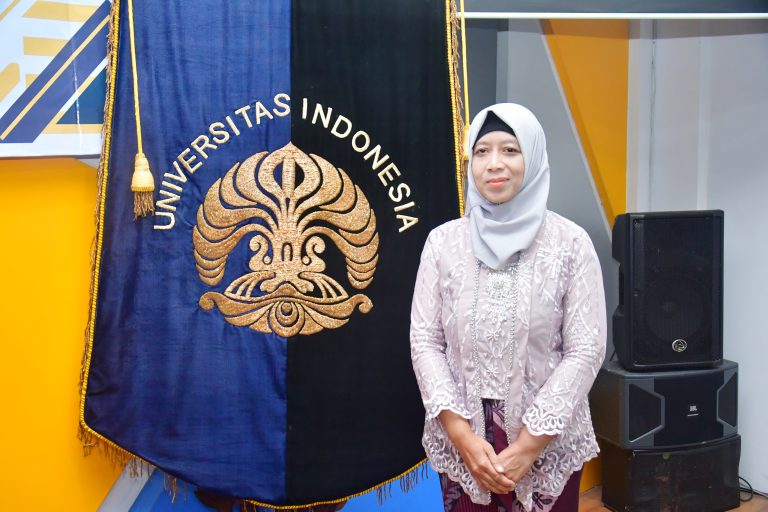
Depok, July 13, 2026 – A researcher from the Faculty of Mathematics and Natural Sciences, Universitas Indonesia (FMIPA UI), has developed a management framework for alien fish invasions that integrates habitat conditions, species characteristics, and population abundance. This approach is expected to strengthen conservation efforts for urban freshwater ecosystems by identifying priority locations and species for management and control.
The framework was developed through research conducted across six aquatic ecosystems in the Greater Jakarta area (Jabodetabek): the Ciliwung, Cisadane, and Cileungsi Rivers, as well as Tonjong, Tunggilis, and Suradita Lakes. The study examined fish community structure, habitat vulnerability, and the invasiveness characteristics of alien fish species, which have long been recognized as a major threat to freshwater biodiversity.
The findings revealed that alien fish accounted for 64.90% of the fish community in river ecosystems, a higher proportion than in lakes, where they represented 50.20%. Species such as Nile tilapia (Oreochromis niloticus) and suckermouth armored catfish (Pterygoplichthys pardalis) were identified as the most dominant alien fish species across several study sites. In addition, the Habitat Vulnerability Score (HVS) model developed in the study identified the lower reaches of the Cileungsi River, the lower reaches of the Ciliwung River, the middle reaches of the Cileungsi River, and the outlet of Tonjong Lake as the areas most vulnerable to alien fish invasions.
“Alien fish invasions are not solely driven by the presence of non-native species, but also by increasingly degraded habitat conditions. Therefore, effective management must address both aspects simultaneously,” said Noer.
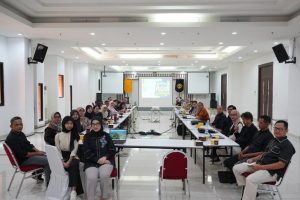
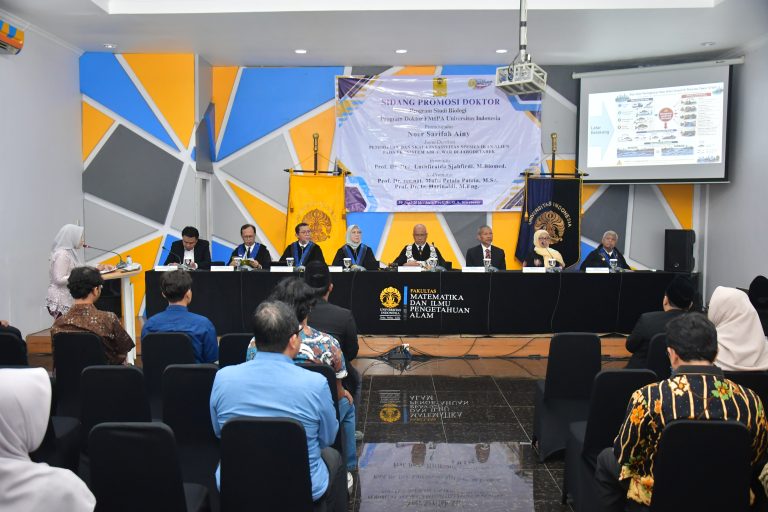
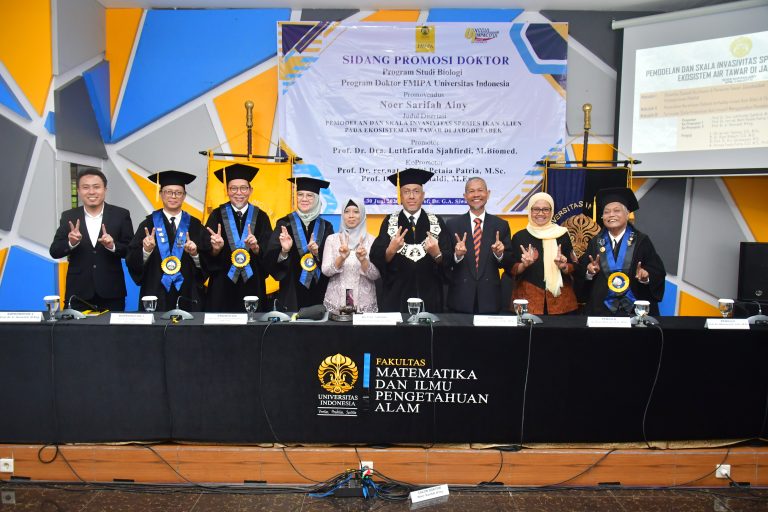
The findings were presented by Noer Sarifah A’iny during her doctoral dissertation defense in the Biology Doctoral Program at FMIPA UI, held at the Prof. G.A. Siwabessy Auditorium, FMIPA UI, Depok, on Tuesday (June 30). She earned her doctoral degree with a cumulative grade point average (GPA) of 3.94 and graduated cum laude after completing her studies in six semesters. The defense was chaired by the Vice Dean for Education, Research, and Student Affairs of FMIPA UI, Prof. Anom Bowolaksono, Ph.D., with Prof. Dr. Luthfiralda Sjahfirdi, M.Biomed., serving as the promoter, and Prof. Dr. rer. nat. Mufti Petala Patria, M.Si., and Prof. Dr. Ir. Harinaldi, M.Eng., as co-promoters.
In her dissertation, Noer also developed the Invasiveness Scale, an assessment tool designed to evaluate the threat level of individual alien fish species based on their adaptive capacity, environmental tolerance, population dominance, resource-use flexibility, and reproductive potential. By integrating the Habitat Vulnerability Score (HVS), the Invasiveness Scale, and species abundance, the study produced a comprehensive management framework that enables more effective prioritization of conservation efforts.
According to the study, this approach can serve as a foundation for developing strategies to control alien fish species, protect native fish refugia, restore habitats, and establish early warning systems for the spread of invasive species in tropical urban freshwater ecosystems.
“I hope the framework developed through this research can serve as a foundation for monitoring, setting conservation priorities, and informing policy decisions aimed at protecting freshwater ecosystems, particularly in urban areas,” said Noer.
This research represents one of FMIPA UI’s contributions to advancing the fields of aquatic ecology and biodiversity conservation. The integrative framework developed through the study not only provides comprehensive data on the condition of fish communities in the freshwater ecosystems of the Greater Jakarta area (Jabodetabek), but also offers a practical approach that can be adapted for freshwater ecosystem management in other urban regions across Indonesia.