
|
From Cancer DNA to Radiopharmaceuticals, Two FMIPA UI Researchers Receive Indonesia–Netherlands Research Funding
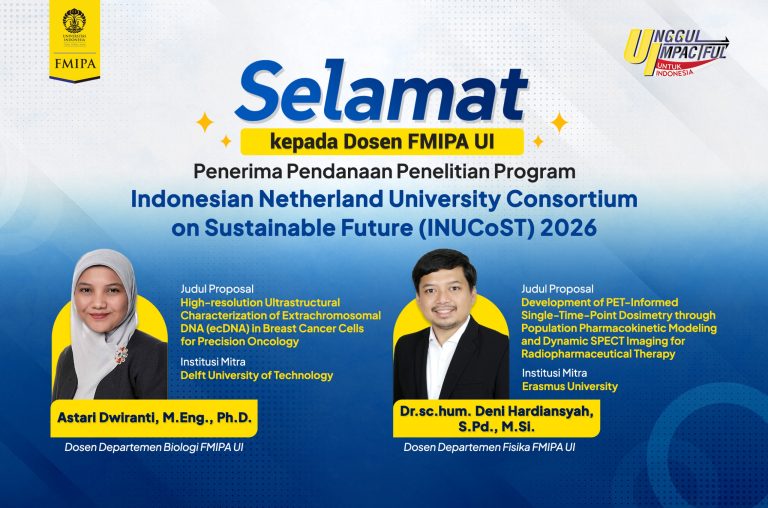
Two researchers from the Faculty of Mathematics and Natural Sciences, Universitas Indonesia (FMIPA UI), have secured research funding through the Indonesian–Netherlands Universities Consortium for Sustainable Futures (INUCoST) 2026 program. They are Astari Dwiranti, M.Eng., Ph.D. from the Department of Biology and Deni Hardiansyah, Dr.sc.hum., S.Pd., M.Si. from the Department of Physics.
The Indonesian–Netherlands Universities Consortium for Sustainable Futures (INUCoST) program is a research collaboration consortium between Indonesia and Netherlands, funded by the Lembaga Pengelola Dana Pendidikan (LPDP) and managed by the Kementerian Pendidikan Tinggi, Sains, dan Teknologi Republik Indonesia, particularly through the Direktorat Penelitian dan Pengabdian kepada Masyarakat under the Direktorat Jenderal Riset dan Pengembangan. The selection of funding recipients is conducted through joint deliberation by a committee involving the Leiden-Delft-Erasmus Universities Alliance and Lembaga Pengelola Dana Pendidikan. In 2026, the program awarded research funding to 10 researchers from Indonesia.
ecDNA Research for Precision Oncology
Astari Dwiranti, M.Eng., Ph.D., received funding for a research proposal titled “High-resolution Ultrastructural Characterization of Extrachromosomal DNA (ecDNA) in Breast Cancer Cells for Precision Oncology.” The study will be conducted in collaboration with researchers from Delft University of Technology in the Netherlands.
The research focuses on the ultrastructural characterization of extrachromosomal DNA (ecDNA) in breast cancer cells using a high-resolution approach. The study is expected to provide deeper insights into the role of ecDNA in cancer development, while also opening opportunities for the development of precision therapies in the field of oncology.
In an interview with the communications team of the Faculty of Mathematics and Natural Sciences at Universitas Indonesia, Astari Dwiranti explained that extrachromosomal DNA (ecDNA) is genetic material that exists outside the cell’s main chromosomes. Based on previous studies, the presence of ecDNA has been associated with cancer aggressiveness, particularly in breast cancer.
“Inside cancer cells, ecDNA carries genes that can drive more aggressive tumor growth. By studying ecDNA in breast cancer, we aim to understand how cancer cells develop, adapt, and become resistant to therapy,” she explained.
She added that the characteristics of ecDNA are also closely related to cancer cell heterogeneity, which is one of the major challenges in cancer treatment. Therefore, this research is expected to contribute to the development of precision oncology, a therapeutic approach that provides more personalized treatment for each patient.
“Through this research, we hope to identify new molecular biomarkers that can help determine the most appropriate therapy choices by gaining a deeper understanding of the genetic characteristics of cancer,” she explained.
The collaboration with the team from Delft University of Technology was chosen due to their expertise in molecular imaging. This research involves Jacob Hoogenboom and his team, who have developed ultrafast microscopy technology that enables a more comprehensive analysis of ecDNA. This technology is crucial because ecDNA is extremely small in size, requiring very high resolution and magnification to be observed accurately.
In addition, the research also involves collaboration with Dyah Laksmi Dewi, Dr. rer. nat., dr., M.Sc., Sp.B. Subsp. Onk(K), from Universitas Gadjah Mada. This collaboration enables a more comprehensive analysis, both from molecular and ultrastructural perspectives, by utilizing not only cell lines but also clinical samples.
Astari Dwiranti stated that this research has the potential to make an important contribution to cancer management in Indonesia. The findings are expected to enrich the understanding of the molecular characteristics of breast cancer that are relevant to the Indonesian population, while also supporting the development of more precise diagnostic and therapeutic strategies.
She also emphasized that the research will involve students and early-career researchers from the Faculty of Mathematics and Natural Sciences at Universitas Indonesia. “Students from the undergraduate to doctoral levels, as well as young researchers, will be actively involved so that they can gain direct experience in ultrastructural research, molecular biology, and cancer genomics,” she added.
Dosimetry Innovation for Radiopharmaceutical Therapy
Meanwhile, Deni Hardiansyah, Dr.sc.hum., S.Pd., M.Si., received funding through a proposal titled “Development of PET-Informed Single-Time-Point Dosimetry through Population Pharmacokinetic Modeling and Dynamic SPECT Imaging for Radiopharmaceutical Therapy.” The research is conducted in collaboration with partners from Erasmus University Rotterdam, which has extensive experience in radiopharmaceutical-based cancer therapy.
This research aims to develop a more efficient dosimetry method for radiopharmaceutical therapy by utilizing population pharmacokinetic modeling and the integration of PET- and SPECT-based medical imaging.
In an interview with the communications team of the Faculty of Mathematics and Natural Sciences at Universitas Indonesia, Deni Hardiansyah explained that the PET-informed single-time-point dosimetry approach utilizes data on the distribution of radioactive substances in a patient’s body obtained from PET imaging to calculate the absorbed radiation dose more accurately. However, its application remains limited because of the differences in the types of radioisotopes used for PET imaging and for therapy.
To address this challenge, the research employs population-based mathematical modeling that integrates patient physiological information and artificial intelligence techniques. This approach enables more precise dose estimation by utilizing data from multiple patients simultaneously.
According to Deni Hardiansyah, this method has the potential to provide significant benefits for cancer therapy in Indonesia. Currently, most hospitals still use the same dosage for all patients in radiopharmaceutical therapy, even though each patient has different physiological conditions.
“Therapy using radioactive substances carries radiation risks, therefore the dosage should ideally be personalized,” he said.
So far, individual dosimetry has been difficult to implement because it requires repeated imaging of the patient’s body—around three to five times, which increases both the cost and complexity of the procedure. The method developed in this research seeks to address this limitation by requiring only a single imaging session.
He noted that this approach also has the potential to improve the efficiency and accessibility of radiopharmaceutical therapy. PET data, which are routinely used for diagnosis, can be further utilized to calculate therapeutic radiation doses without adding extra costs for hospitals.
At the initial stage, the research team will process clinical data from partner hospitals in the Netherlands to test the modeling method being developed. Subsequently, the method will be evaluated using data from hospitals in Indonesia to support the development of national protocols for cancer therapy.
This research also involves collaboration with Freddy Haryanto from Institut Teknologi Bandung (ITB). In addition, master’s and doctoral students from the Faculty of Mathematics and Natural Sciences at Universitas Indonesia and ITB will also be involved in the research activities as part of efforts to strengthen the capacity of young researchers in the fields of medical physics, medical imaging, and radiopharmaceutical therapy.
Encouraging International Research Collaboration
The achievement of the two researchers from the Faculty of Mathematics and Natural Sciences at Universitas Indonesia in the Indonesian–Netherlands Universities Consortium for Sustainable Futures (INUCoST) program reflects the growing contribution of Indonesian researchers in international research collaborations, particularly in the fields of biomedicine and health technology. This collaboration is expected to accelerate the advancement of scientific knowledge while also generating innovations with tangible impacts for society, both in the development of cancer therapies and in strengthening research capacity in Indonesia.
Post Views: 329
Share this:
Facebook
X
LinkedIn
WhatsApp
Email
Tumblr
Telegram
Print
Other News