
|
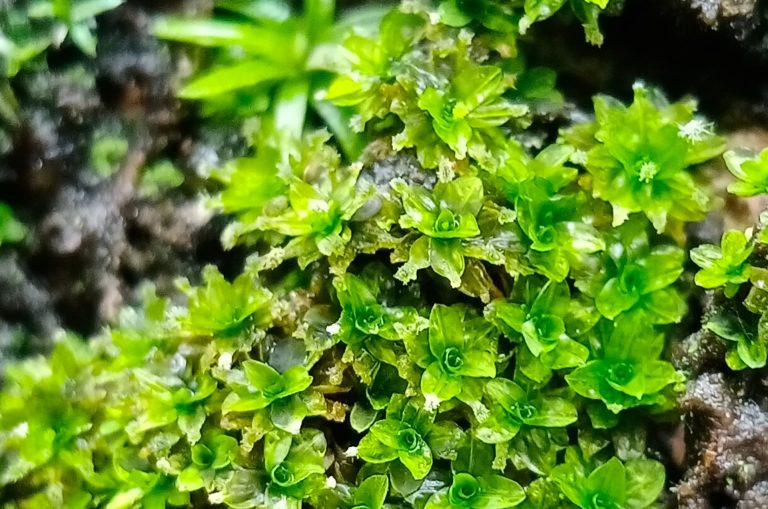
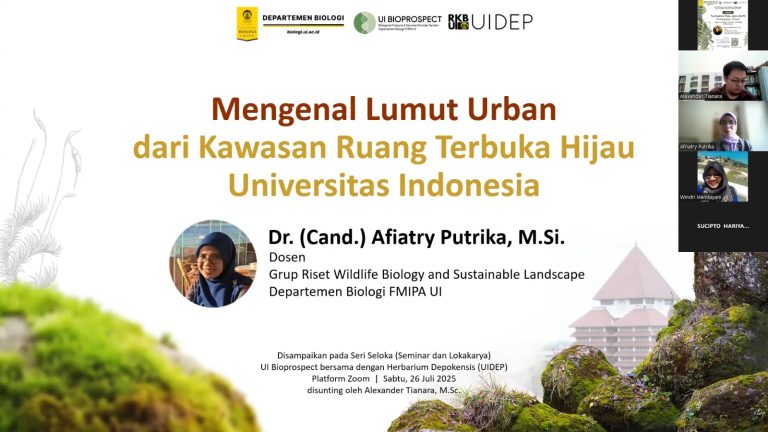
In an effort to broaden public awareness of plant biodiversity in urban areas, the Faculty of Mathematics and Natural Sciences, Universitas Indonesia (FMIPA UI), through the Department of Biology and the Depokensis Herbarium (UIDEP), held a scientific presentation delivered by Afiatry Putrika, M.Si., a lecturer and researcher in the field of botany, particularly focusing on mosses (Bryophyta).
The event was presented in the form of a webinar titled “Getting to Know Urban Mosses from the Green Open Spaces of Universitas Indonesia,” which took place on Saturday (July 27).
Mosses are often overlooked and even mistakenly perceived as slimy algae that make surfaces slippery. In fact, from a scientific perspective, mosses are non-vascular plants that play a vital ecological role in various ecosystems, including urban areas such as the UI campus in Depok.
“Mosses are not just small plants that grow in damp places; they are guardians of urban ecosystems that are often overlooked,” said Afiatry at the beginning of her presentation.
Afiatry explained that mosses have a very simple body structure. Without vascular tissues such as xylem and phloem, mosses absorb water and nutrients directly through the surface of their bodies—an important adaptation that enables them to survive in environments ranging from moist to semi-arid.
Taxonomically, mosses have long been a complex topic in systematic botany. Initially classified under a single large division called Bryophyta, the group is now divided into three separate divisions based on distinct evolutionary lineages: Bryophyta (true mosses), Marchantiophyta (liverworts), and Anthocerotophyta (hornworts). Each of these divisions possesses its own diagnostic characteristics, both in terms of morphology and physiology.
The UI campus area itself is home to a variety of moss species that reflect the high biodiversity of urban flora. True mosses in this area are distributed across eight families, including Calymperaceae and Hypnaceae, which are commonly found growing on rocks and hard surfaces. Meanwhile, liverworts such as those from the Lejeuneaceae family are often found on tree trunks, while Marchantiaceae are frequently encountered on wall surfaces and drainage canal walls around the campus.
“Mosses are not a scientifically simple group — they are divided into three distinct divisions, both evolutionarily and morphologically. Interestingly, all three groups can be found within the UI campus environment, showing that even urban spaces possess remarkable floral richness,” she added.
More than just species diversity, mosses play various ecological roles in urban environments: serving as pioneer plants in ecological succession processes, stabilizing soil and preventing erosion, increasing soil moisture, and acting as bioindicators of air quality through the calculation of the Index of Atmospheric Purity (IAP).
The biomonitoring study presented showed that the IAP values in residential and industrial areas around Depok indicate high to very high pollution levels, underscoring the importance of mosses as a biological early warning system.
In addition to their ecological benefits, mosses also possess economic and aesthetic value in horticulture and landscape design. Innovations such as urban moss biofilters developed by the German company Green City Solution, as well as artistic practices like Kokedama and Preserved Moss Art, demonstrate the great potential of these plants in the fields of bioprospecting and modern ecological art.
Through this scientific presentation, Afiatry emphasized the importance of changing the public’s perception of these small plants: from being seen as insignificant or even unpleasant, to being recognized as vital living organisms that support the balance of urban ecosystems and open up further research opportunities in the fields of botany, ecology, and bioinspiration.
"By recognizing and understanding their role, we can see how important their presence is in maintaining the quality of the urban environment," said Afiatry in closing her presentation.
Herbarium Depokensis (UIDEP), as a plant conservation and research institution at Universitas Indonesia, remains committed to expanding public access to botanical science literacy. This presentation is part of that mission, as well as an invitation to take a closer look at the biodiversity that exists right around us.