
|
FMIPA UI Delivers Fertilizer Produced from Organic Waste Processing to Support Waste Management in Depok

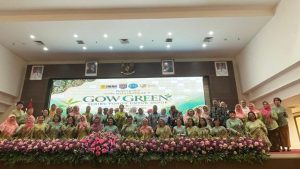
Depok, September 18, 2026 — The Faculty of Mathematics and Natural Sciences, Universitas Indonesia (FMIPA UI), presented fertilizer produced by the UI Biodigester Laboratory during the main celebration of the 37th anniversary of the Depok City Women’s Organizations Association (GOW) on Wednesday (September 2, 2026). The fertilizer was produced through the processing of organic waste at the laboratory facility.
The handover took place on the 10th floor of Dibaleka 2 Building at Depok City Hall as part of an event themed “Greening Depok, Leaving a Legacy for Future Generations.” The event also formed part of efforts to promote waste management at the source, including the utilization of organic waste to produce reusable products.
Dean of FMIPA UI, Prof. Dr. Tito Latif Indra, S.Si., M.Si., said that research outcomes and laboratory facilities should continue to be directed toward addressing issues faced by the community. The delivery of fertilizer produced by the UI Biodigester Laboratory is one form of support for efforts to manage organic waste.
“Through the delivery of fertilizer produced by the biodigester, we aim to support organic waste management efforts while demonstrating that research outcomes can be utilized to address environmental issues in the community,” said Tito.
Depok Mayor Supian Suri said that waste reduction needs to begin at the household level with community involvement, including women’s organizations.
“We hope GOW can serve as a driving force for environmental awareness and waste management efforts,” said Supian.
According to Supian, the Cipayung Final Disposal Site (TPA) receives approximately 1,200 tons of waste per day. The Depok City Government has partnered with the Bogor City Government on a waste-to-electricity management initiative. Of the total, 700 tons of waste are sent to Bogor, while the remaining 500 tons are managed by a third party.
The Depok City Government also runs several community-level waste reduction programs. One of them is Pom SS, which collects used cooking oil in each urban village. There is also the Blue Bucket program in Duren Seribu Urban Village, which processes organic waste into fertilizer and turns plastic waste into economically valuable products with the involvement of women’s organizations.
Processing organic waste through a biodigester is one approach to reducing the amount of waste sent to final disposal sites. This technology utilizes biological processes to treat organic materials and produce outputs that can be reused.
Waste reduction at the source is also part of the national waste management agenda. The government aims to increase the percentage of managed waste to 100 percent by 2029 by strengthening waste reduction and management efforts from upstream to downstream.
The delivery of fertilizer produced by the UI Biodigester Laboratory as part of the Depok City GOW event represents one form of applying scientific development to environmental issues at the community level. Further application of this technology can be developed through collaboration among higher education institutions, local governments, and communities, tailored to the needs of organic waste management.
Post Views: 19
Share this:
Facebook
X
LinkedIn
WhatsApp
Email
Tumblr
Telegram
Print
Other News