
|
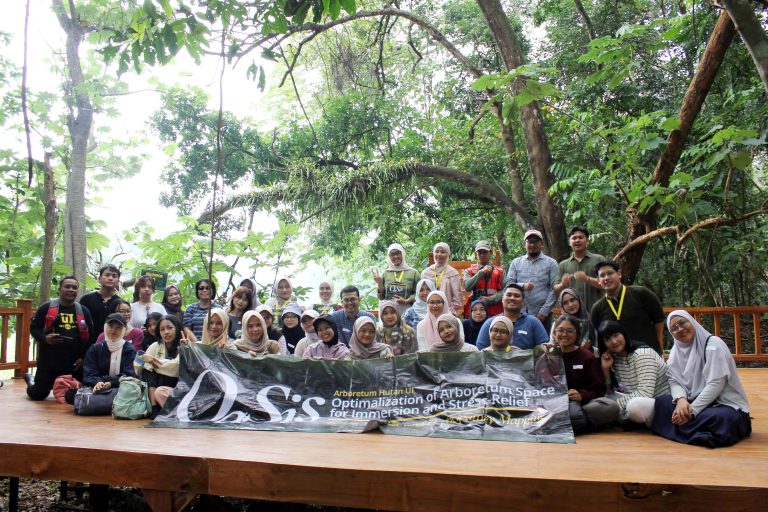
Depok, October 8, 2026 — Students from the Faculty of Mathematics and Natural Sciences, Universitas Indonesia (FMIPA UI), in collaboration with the Faculty of Nursing (FIK UI), have developed the OASIS forest therapy program at the UI Forest Arboretum to help young adults aged 18–25 in urban areas manage stress. The program combines participatory mapping grounded in geography with a mental health nursing approach to identify forest areas that may support psychological recovery.
Supported by a Community Care Grant from the Directorate of Community Engagement and Social Innovation (DPIS UI), the OASIS program (Optimalization of Arboretum Space for Immersion and Stress-Relief): , entitled “Forest Therapy Based on Participatory Mapping in the UI Forest for Psychological Restoration of Young Adults at Risk of Distress in South Jakarta,” was carried out through two activities: Terrain Emotional Mapping on Saturday, September 26, 2026, and Leaf Journaling for Healing Saturday, October 3, 2026. Both activities involved student volunteers from various faculties at Universitas Indonesia.
The OASIS program involves students from the 2023 cohort of the Department of Geography at FMIPA UI, led by Donanda Septian Putra and supervised by field advisor Prof. Dr. Drs. Supriatna, M.T., Geog.PU. The team also consists of Muhammad Rafli, Ammara Fazila Putri Bethasonny, Muhamad Danar Pridana, Khobilal Salsya Rusalbi, Mu’amar Khadafi, Shayla Claristha Taruna, Chantika Afiyara Zahwah, and Satrio Karita Putra.
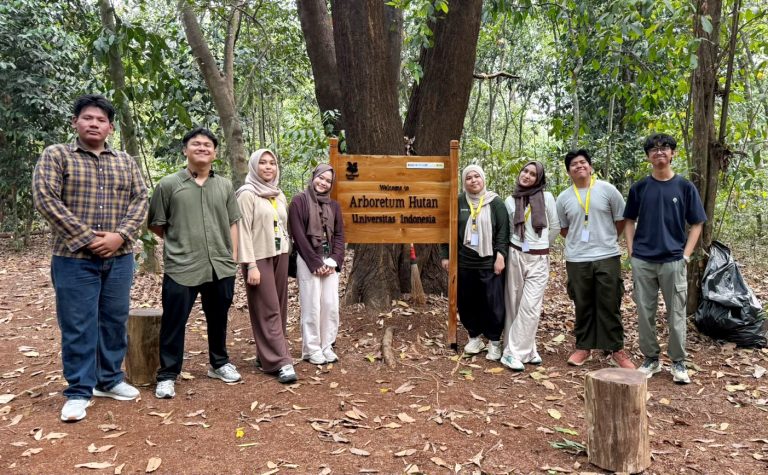
The program is designed as a restorative space for young people experiencing the pressures of urban life. Through forest therapy, the natural forest environment is utilized to support mental well-being. This approach is combined with participatory mapping, in which participants' experiences are used to identify forest areas they perceive as conducive to psychological recovery.
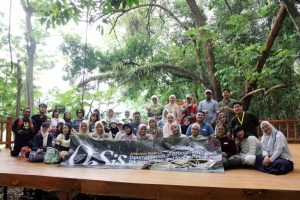
During the first activity, participants followed a route through the UI Forest Arboretum featuring five stations, each with a different activity. These included pernapasan dalam (deep breathing), exercises, mental health education, coloring, group storytelling, and papan reflektif (board game). At each station, participants assessed changes in their moods and recorded what they saw, heard, and felt. These observations were used to map their experiences and responses to the forest environment.
The data collected at each station were processed into digital maps illustrating participants' mood responses at different locations in the UI Forest. This spatial data analysis represents the Department of Geography at FMIPA UI's primary contribution to the OASIS program. By linking mood assessments with specific locations, the team could compare participants' experiences at each station. The resulting maps are expected to serve as a reference for selecting locations for future forest therapy activities.
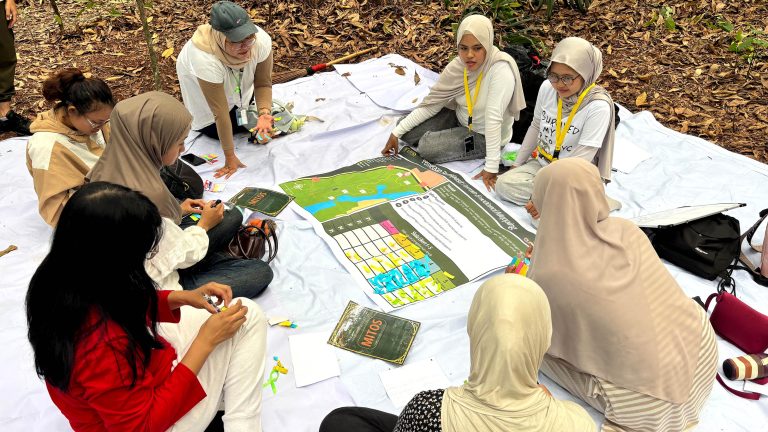
OASIS Team Leader Donanda Septian Putra, a Geography student from the 2023 cohort, explained that Terrain Emotional Mapping was designed not only to collect data but also to encourage participants to recognize their emotional states while spending time in the forest. Through the activities at each station, participants were invited to reflect on their feelings, comfort levels, and responses to their surroundings.
“Through this activity, we want participants to engage actively and become more aware of what they feel at each location. They are encouraged to notice whether they feel calmer, more comfortable, or refreshed after spending time in nature. In this way, participants not only help us collect data but also have the opportunity to better understand their own emotional states,” Donanda explained.
Unlike the first activity, which mapped mood responses according to location, the second activity focused on self-reflection through Leaf Journaling for Healing. Participants expressed their thoughts, feelings, and experiences in journals, then decorated them using fallen leaves and dried plants collected from the natural surroundings. This activity provided an opportunity for participants to express their emotions, ease tension, and find a sense of calm through interaction with the environment.
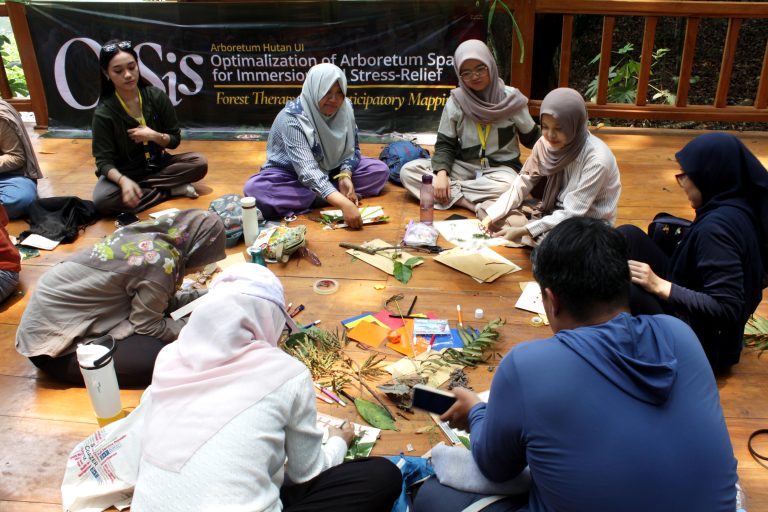
Overall, the OASIS program involved more than 30 participants from urban young adult communities. One participant, Choirunnisa, shared that spending time in the forest helped her feel calmer and think more clearly.
“Enjoying every step, looking at the trees and the green leaves, accompanied by the calls of birds and crickets, felt as though something was lifting from my mind. The burden began to feel lighter—not because the problems had disappeared, but because I felt a shift in energy that allowed me to think more clearly,” Choirunnisa said.
Through the OASIS program, students from the Department of Geography at FMIPA UI have demonstrated how geographical knowledge can be applied to address mental health challenges in urban environments. Through participatory mapping, students not only analyze spatial data but also develop a nature-based approach that incorporates participants' personal experiences. This initiative reflects FMIPA UI students' contribution to promoting the use of the UI Forest as a space that supports psychological recovery while fostering greater awareness of mental health and environmental conservation.