
|
Amid the rising risk of disasters and the rapid pace of infrastructure development, the ability to interpret natural warning signs has become increasingly crucial. For those in engineering geology, this can no longer rely solely on conventional observation, but must be supported by integrated, data-driven monitoring systems.
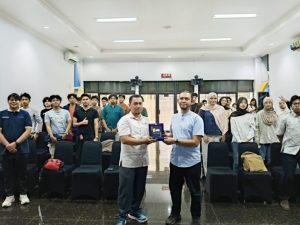
The issue was highlighted in a guest lecture for the Engineering Geology course attended by students of the Geology Study Program at the Faculty of Mathematics and Natural Sciences, Universitas Indonesia (FMIPA UI), on Wednesday, February 25, 2026, in Room B404, Building B, FMIPA UI.
Raising the theme of smart geotechnical monitoring for early warning system, the event featured two speakers from PT. Telematika Aset Monitoring, who shared their perspectives on how geotechnical monitoring technology is utilized to detect potential hazards early, while also supporting data-driven decision-making in the field.
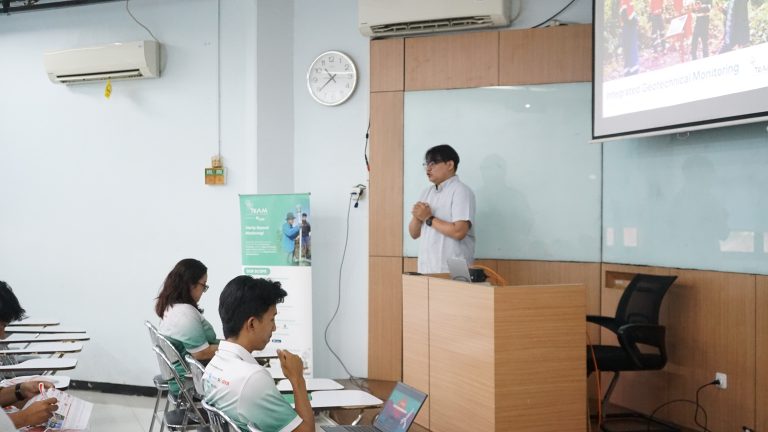
In his opening remarks, FMIPA UI Engineering Geology lecturer Twin Hosea W. K. emphasized that a geologist’s role is not only to understand subsurface conditions, but also to ensure the safety of a project and its surrounding environment.
“Monitoring and maintenance are inseparable components, especially in anticipating potential instabilities that could lead to disasters,” he stated.
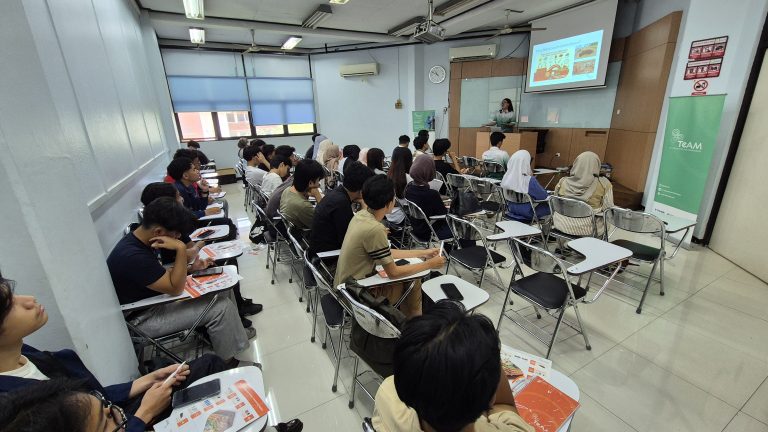
Reading Data, Predicting Risk
Ruth Amelia explained that geotechnical monitoring is essentially a continuous process of reading and interpreting data.
“Monitoring is not merely about installing instruments, but about how we integrate data, time, and trends. From there, we can assess whether a slope or infrastructure is still in a safe condition or not,” she explained.
According to her, the data generated by sensors will form certain patterns. These patterns then become the basis for decision-making, including in early warning systems. This approach is widely applied in large-scale projects such as dams, tunnels, and highways.
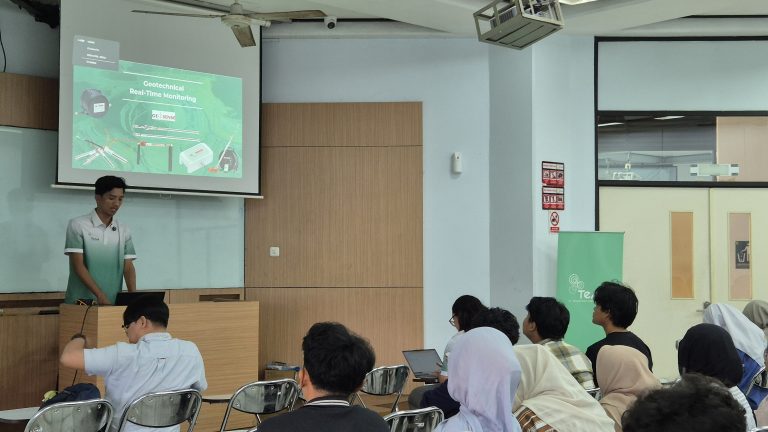
The Role of Instruments in Early Detection
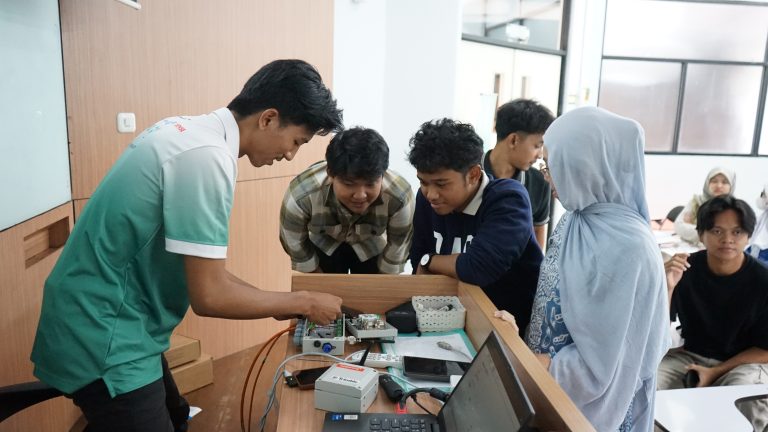
Meanwhile, Bimantara Budi Arifin presented various instruments used in geotechnical monitoring. One of them is the piezometer, which functions to measure pore water pressure beneath the ground surface.
“Pore water pressure has a significant influence on slope stability. With this instrument, we can detect changes in conditions before a landslide occurs,” he explained.
In addition, there are also joint and crackmeter , as well as other instruments such as extensometers and inclinometers, which are used to measure ground deformation. These tools are widely used on highway slopes and in open-pit mining areas.
For students, being introduced to these instruments is important as it provides a real-world understanding of how the theories learned in the classroom are applied in the field.
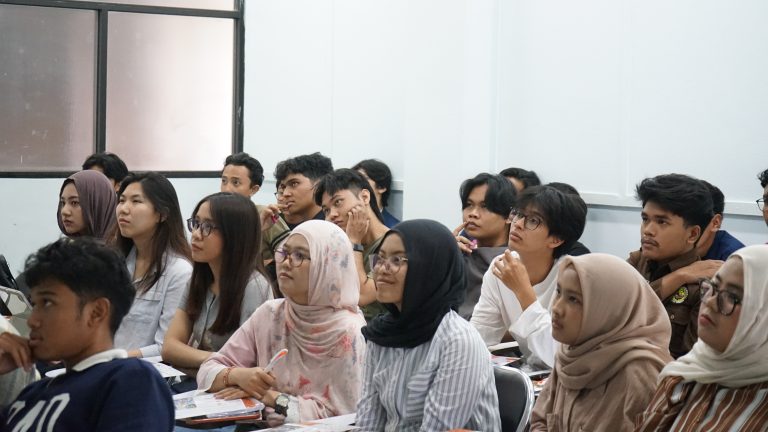
Real-Time Data and Warning Systems
In the discussion session, students highlighted the accuracy and speed of monitoring systems in providing warnings. In response, Bimantara explained that current technology enables real-time data acquisition real-time.
“When the recorded data approaches a threshold, the system will automatically send an alert to the server. From there, the team can immediately take action to reduce risk,” he explained.
He added that to maintain accuracy, incoming data is not used immediately, but instead goes through several stages of validation. This step is important to ensure that the warnings issued truly reflect the actual conditions in the field.
This activity is part of the Geology Study Program at FMIPA UI’s efforts to strengthen students’ competencies, particularly in addressing challenges related to disasters and sustainable development.
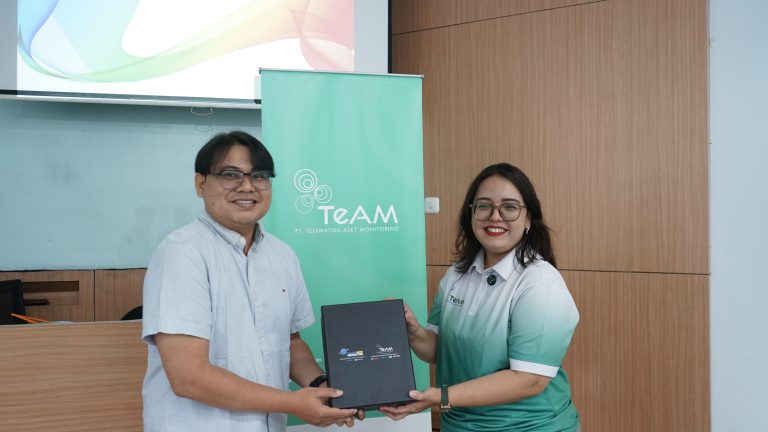
Through collaboration with industry practitioners, students not only gain theoretical understanding but also practical experience relevant to industry needs. This aligns with FMIPA UI’s commitment to producing resilient graduates who are ready to contribute across various strategic sectors.
More than just an academic activity, this guest lecture demonstrated that the future of engineering geology increasingly depends on the ability to process data and utilize technology. With this approach, potential disasters can not only be understood but also anticipated at an early stage.