
|

Depok, September 14, 2026 — Indonesia is one of the world’s largest natural laboratories. More than 17 percent of the world’s bird species are found in Indonesia, along with more than 770 mammal species, 16 percent of the world’s reptile and amphibian species, and more than 31,000 species of vascular plants. This wealth of biodiversity makes Indonesia one of the world’s most important countries for biological diversity.
However, this natural wealth also presents a major challenge: how to understand, protect, and sustainably utilize biodiversity. Deforestation, habitat fragmentation, illegal hunting, and climate change continue to threaten the survival of numerous species. Under these circumstances, conservation requires more than awareness alone. Scientific data and knowledge are essential foundations for determining how nature can be protected and sustainably utilized.
This challenge has been at the heart of the academic career and public service of Prof. Drs. Jatna Supriatna, M.Sc., Ph.D., Professor of Conservation Biology at the Faculty of Mathematics and Natural Sciences, Universitas Indonesia (FMIPA UI), for more than four decades.
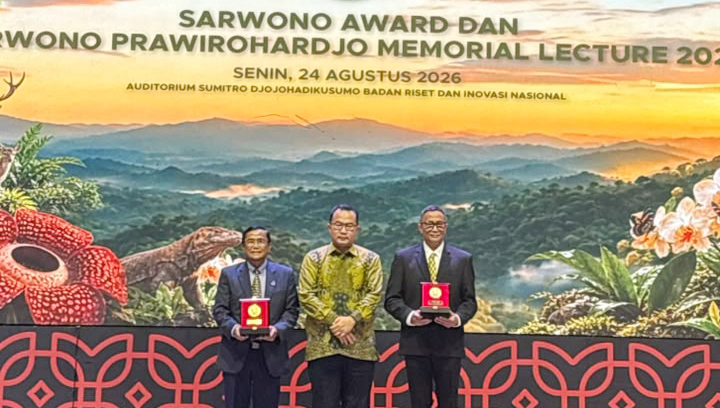
On August 24, 2026, this dedication was recognized through Sarwono Award 2026, an award lifetime achievement presented by the National Research and Innovation Agency (BRIN) in collaboration with the Indonesia Endowment Fund for Education (LPDP). The award recognized his track record in research, development, and dissemination of science and technology in the field of science, technology, engineering, and mathematics (STEM).
For Prof. Jatna, the award does not mark the end of his journey. Instead, he sees it as a reminder that there is still a long way to go in fulfilling his responsibility to science and Indonesia’s natural environment.
“ I accept this award not as a sign that the journey has come to an end, but as a reminder that our responsibility to science and Indonesia’s natural environment is far from over,” said Prof. Jatna.
The journey began with field research. Prof. Jatna developed his passion for research through studies of orangutans and red langurs in Tanjung Puting National Park, Central Kalimantan. From the forest, his work expanded into various fields that brought together research, education, conservation, and environmental policy.
He led Conservation International Indonesia from 1995 to 2010 and founded the Research Center for Climate Change, Universitas Indonesia (RCCC-UI) in 2010 in response to the challenges posed by climate change. At FMIPA UI, he also helped initiate the SDG Hub in 2020.
These efforts have gone hand in hand with his contributions at the international level. Prof. Jatna has been entrusted with serving as a Co-chair the Southeast Asia Primate Specialist Group of the International Union for Conservation of Nature (IUCN) and has served on the steering committee of the Center for Nature-Based Climate Solutions at the National University of Singapore. His academic track record is also reflected in more than 240 scientific publications in international journals and 30 books on environmental topics.
From Forests to Policy
For Prof. Jatna, biodiversity research does not end with data collection or scientific publications. Knowledge generated through field research needs to be translated into a foundation for decision-making.
This perspective was also reflected in the 2026 Sarwono Prawirohardjo Memorial Lecture delivered by Prof. Dr. Gono Semiadi, Research Professor at the BRIN Research Center for Biosystematics and Evolution. In his lecture, Gono emphasized the importance of science-policy interface, the connection between scientific evidence and nature conservation policies.
This perspective is closely aligned with Prof. Jatna’s decades-long work in connecting conservation research with real-world challenges in the field. For him, science should have a meaningful impact on people’s lives.
“Science must not stop at journals, seminar rooms, or library shelves. Science must serve life,” he said.
This perspective also stems from the way Prof. Jatna views forests. Forests are not merely collections of trees, but living spaces and sources of knowledge about evolution, climate adaptation, food, medicine, water, and culture.
Therefore, conservation cannot be separated from human life. Well-preserved forests and landscapes are closely linked to water management, carbon storage, biodiversity, food, livelihoods, and the development of nature-based tourism.
Conservation as an Investment in the Future
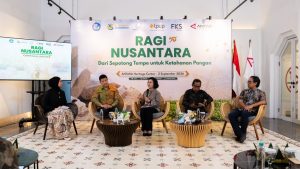
This perspective has also evolved through several of Prof. Jatna’s works on the relationship between communities and environmental sustainability. At the launch and discussion of his three books, he emphasized the community’s important role in conservation efforts.
The three books are: Etnobiologi dan Konservasi Sumber Daya Hayati Berbasis Masyarakat Adat di Indonesia, Pariwisata dan Perubahan Iklim, as well as Biologi Konservasi Indonesia, share a common message: the protection of natural areas and wildlife must go hand in hand with scientific knowledge, policy, economic activities, and community participation.
“Efforts to protect nature require the integration of scientific knowledge, policy, economic activities, and active community participation,” he added.
Within this framework, ecosystem restoration goes beyond tree planting. Restoration efforts must encompass the recovery of ecological functions and biodiversity, research and monitoring, the selection of adaptive plant species, as well as collaboration with communities and stakeholders.
Four decades of Prof. Jatna’s journey demonstrate how the field of conservation biology can extend from field research into education, policymaking, and international collaboration. The recognition he received through the 2026 Sarwono Award also places this journey in a broader context: protecting Indonesia’s biodiversity is not only about saving species, but also about preserving the ecological foundations that sustain human life.
From forests that serve as spaces for research to policy arenas that shape the future of the environment, conservation ultimately rests on one fundamental principle: using scientific knowledge as a foundation for understanding nature while safeguarding its long-term sustainability.