
|
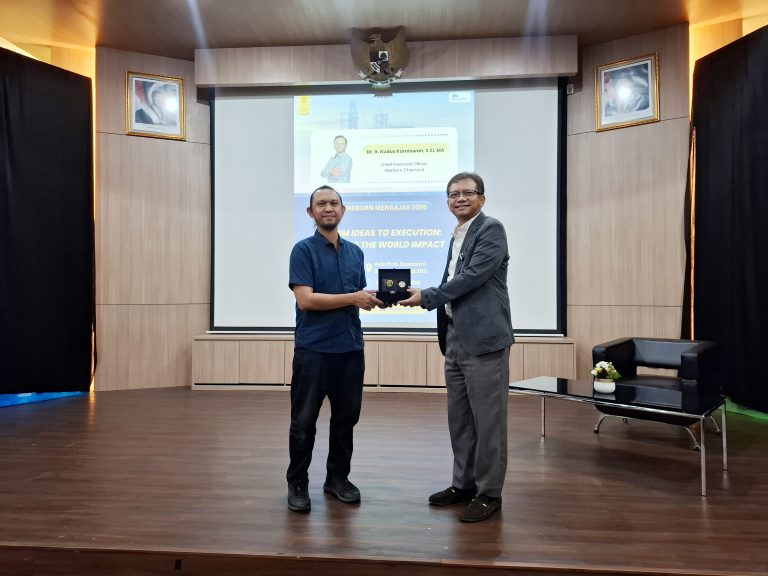
Depok, September 22, 2026 — Students of the Faculty of Mathematics and Natural Sciences, Universitas Indonesia (FMIPA UI), were encouraged not to stop at generating ideas, but to take the initiative to turn those ideas into actions that create tangible impact. This was one of the key topics discussed at the UI Geoscience Seminar x Starborn Mengajar, titled From Ideas to Execution: Making the World Impact, organized by the Geology and Geophysics Study Programs of FMIPA UI on Monday (September 21, 2026), at the Prof. Soemantri Brodjonegoro Hall, FMIPA UI.
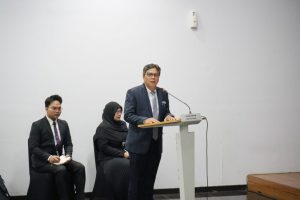
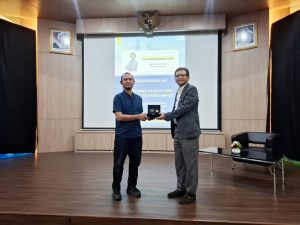
The seminar featured Dr. Ir. Kudus Kurniawan, S.Si., M.A., Chief Financial Officer of Starborn Chemical, as the speaker. Through the 2026 UIGS x Starborn Mengajar program, students gained insights into the professional world from practitioners in their respective fields.
Kudus said that Starborn Chemical's collaboration with UI through the program was designed as a form of experience sharing that complements classroom learning. Students are expected to gain a better understanding of the situations they may encounter when entering the workforce.
According to Kudus, learning directly from practitioners is important so that students not only understand theories but also learn how ideas are applied in real-world situations.
In his presentation, Kudus encouraged students to first reflect on the goals they want to achieve in life. These goals may include achieving success, attaining financial independence, completing their education, or contributing to the well-being of others.
He also shared his personal experience of once setting a goal to build a factory after completing his education. The experience illustrated how a major goal can serve as a starting point for determining the steps and actions needed to achieve it.
Kudus then explained four key stages in executing an idea: identify the problem, define the values, experiment, and align.
The first stage is to identify the problem that needs to be addressed. Next, the value that the idea is intended to create needs to be clearly defined. The idea is then tested through experimentation based on the principle of we should try everything, before all relevant elements are aligned toward a common goal.
“The world never runs out of ideas. Failure is also one of the ways we can create an impact on the world,” said Kudus during his presentation.
He reminded students that not everything they undertake will succeed immediately. Therefore, students need to maintain an open perspective and avoid being constrained by limitations when facing failure.
The main focus, he said, should not simply be whether an idea succeeds in its first attempt, but how the idea can ultimately create impact. Achieving this requires various forms of capital, including brain to think intelligently and social to build networks.
Kudus also emphasized that impact does not always come from large-scale endeavors. Simple tasks carried out consistently can provide insights into broader and more complex issues.
Five Elements of Execution
During the seminar, Kudus elaborated on five elements needed to turn ideas into execution and create an impact for better world. The five elements are clarity, priority, speed, adaptation, and measurements.
Clarity is needed to establish the goals to be achieved. Once the goals are clear, priority helps ensure that available resources are directed toward the most important matters. Meanwhile, speed is necessary to prevent ideas from remaining merely as plans.
At the same time, execution requires the ability to adaptation , as conditions in the field may change. Each step should also be accompanied by measurements to assess the progress and impact generated throughout the process.
According to Kudus, execution is often hindered by fear, excessive perfectionism, and a lack of support from the team. These obstacles can cause people to spend too much time designing ideas without taking the next step toward implementation.
Therefore, he encouraged students not to make their initial ideas overly complicated. Ideas can start on a small and simple scale, making them easier to test and further develop.
Starting Now
Kudus reiterated this message when responding to a student's question about how to develop an idea. According to him, every task should be carried out wholeheartedly while considering the benefits it can provide to others.
During the question-and-answer session, Oliv, a 2024 Geology student, also asked how students can build impact and connections despite their limitations as university students.
Kudus explained that building impact and networks cannot be achieved instantly. Therefore, students should start building their networks early and expand their circles of connections.
He shared his experience of organizing an educational program in Dumai in 1994. Approximately ten years after the program, people involved in the initiative reconnected with him and eventually provided a business opportunity.
The experience demonstrated that relationships built early on can create benefits that may not always be predictable at the time.
Another question from the students concerned the biggest challenges in executing an idea. Kudus once again emphasized the importance of starting with something small and simple.
“Don’t make the idea too difficult. It has to be small and simple. If we make it complicated from the beginning, we will feel reluctant to execute it. So, start with small things first,” he said.
He also encouraged students to be flexible when building relationships with people from different backgrounds. According to him, contributions can take many simple forms, including supporting micro, small, and medium enterprises (MSMEs) or helping people who have lost their jobs regain opportunities to work independently.
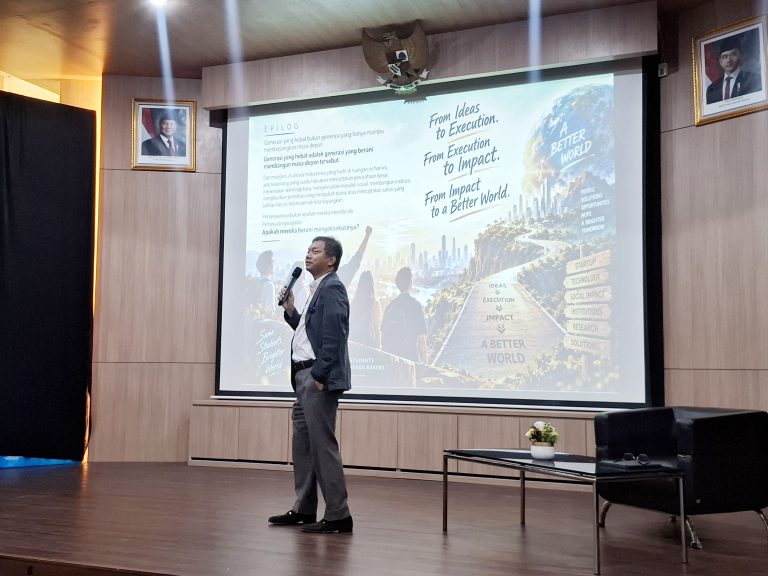
At the end of his presentation, Kudus emphasized that a great generation is not only one that can imagine the future, but also one that has the courage to build it.
He hoped that students attending the seminar would eventually contribute in various ways, from building companies and developing new technologies to addressing social issues, establishing institutions, and conducting research that provides broad benefits.
The message was summarized in the principle that concluded the seminar: “From Ideas to Execution, From Execution to Impact, From Impact to a Better World.”
Through the UI Geoscience Seminar x Starborn Mengajar, students of Geology and Geophysics at FMIPA UI gained not only insights into the professional world but also a broader perspective on execution as an essential process for transforming knowledge and ideas into solutions that can create meaningful impact for society.