
|
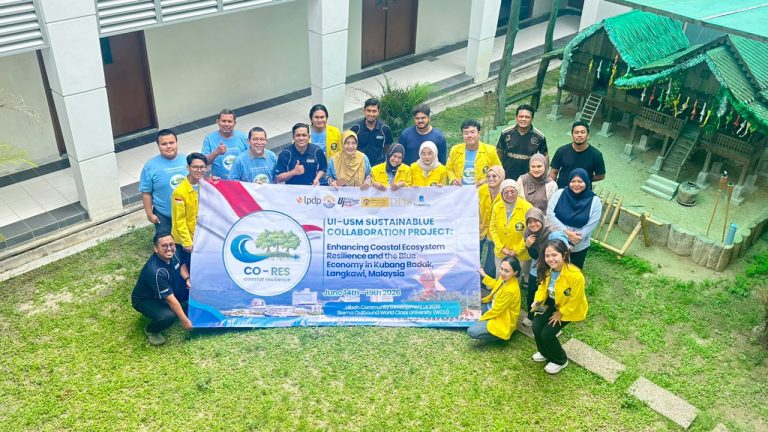
Langkawi, Malaysia — The Faculty of Mathematics and Natural Sciences, Universitas Indonesia (FMIPA UI), in collaboration with the Faculty of Biological Sciences at Universiti Sains Malaysia (USM), is developing a community-based blue economy empowerment model for coastal communities by using Langkawi as a living laboratory. The initiative serves as a learning platform whose approaches are considered highly relevant for adaptation in Indonesia.
The program, titled Enhancing Coastal Resilience and The Blue Economy The program, which took place from 14 to 19 June 2026, formed part of a broader effort to strengthen the capacity of coastal communities through collaboration in education, research, and community engagement between Indonesia and Malaysia.
Retno Lestari, Head of the FMIPA UI Community Engagement Team, explained that Langkawi was selected because it shares many characteristics with several coastal regions in Indonesia. In addition to being one of Malaysia’s leading marine tourism destinations, Langkawi is recognized as a UNESCO Global Geopark, with a management model that integrates conservation, tourism, and community empowerment.
“Langkawi was chosen because it is Malaysia’s premier marine tourism destination and is home to a UNESCO Global Geopark. These characteristics are comparable to those of regions such as the Thousand Islands and the Bali–Lombok area, making the model implemented here a valuable source of learning for Indonesia,” said Retno Lestari.
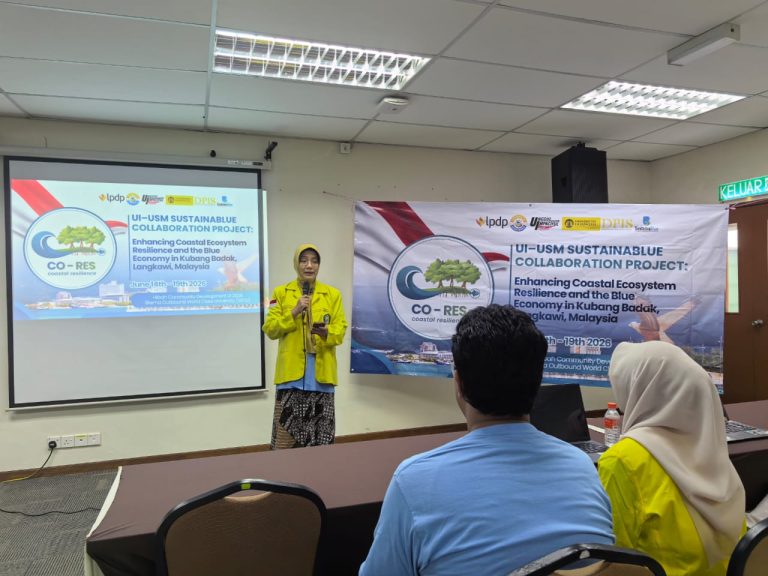
According to Retno Lestari, the greatest challenges to advancing the blue economy in Indonesia and Southeast Asia extend beyond the management of marine resources. They also include addressing economic disparities, expanding equitable access to research-based education in coastal communities, and empowering local communities as the primary drivers of development.
Therefore, FMIPA UI not only transfers knowledge but also develops empowerment models that directly involve the community. During the program's implementation, the UI and USM teams conducted surveys of MSMEs, digital marketing training, a blue economy campaign, discussions on sustainable oyster farming, and dialogues with the Kubang Badak Mangrove Geotrail community. The program involved 41 participants from approximately 15–20 MSMEs and benefited 91 coastal community members in Langkawi.
The collaboration builds on the SustainaBlue Program, an initiative supported by the European Union to enhance the quality of blue economy education at higher education institutions in Indonesia and Malaysia. One of the program’s key outcomes is the SustainaBlue Module, an online learning platform jointly developed by Universitas Indonesia, Universiti Sains Malaysia, and two partner universities for use by both students and the wider public.
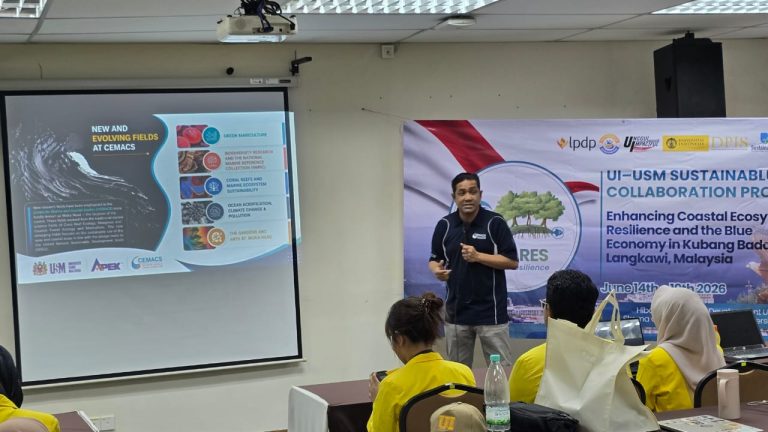
Mahadi Mohammad, Director of the Centre for Marine and Coastal Studies (CEMACS) at Universiti Sains Malaysia (USM), stated that collaboration among higher education institutions is an important step toward strengthening public understanding of the blue economy while expanding its impact across the region.
“Through this collaboration, we aim to enhance public awareness and understanding of the blue economy. Looking ahead, we hope to increase the number of collaborative projects, further improve the quality of our programs, and ensure that this partnership continues to grow in the years to come,” said Mahadi Mohammad.
The FMIPA UI community engagement program was carried out by a team led by Retno Lestari, with support from Mufti Petala Patria, Coordinator of the Sustainable Blue Economy Centre at Universitas Indonesia; program consultants Fajar Reza Budiman, Amelia Said, and Nabil Ariq Ahmad Nurzahid; as well as nine students and alumni of the Department of Biology, FMIPA UI: Niken Laoren, Rakha Nabillutra Falah, Cloudya Zefanya, Ahura Zia Fiwansjah, Kendra Elvina Rosano, Hedza Fadli Robbina, Ilma Ardelia, Ushulil Hidayat, and Syaqila Putri Maharani.
Through this collaboration, FMIPA UI hopes that the conservation-based community empowerment model developed in Langkawi can be adapted across coastal regions in Indonesia to strengthen community resilience while ensuring the long-term sustainability of coastal and marine ecosystems.