
|
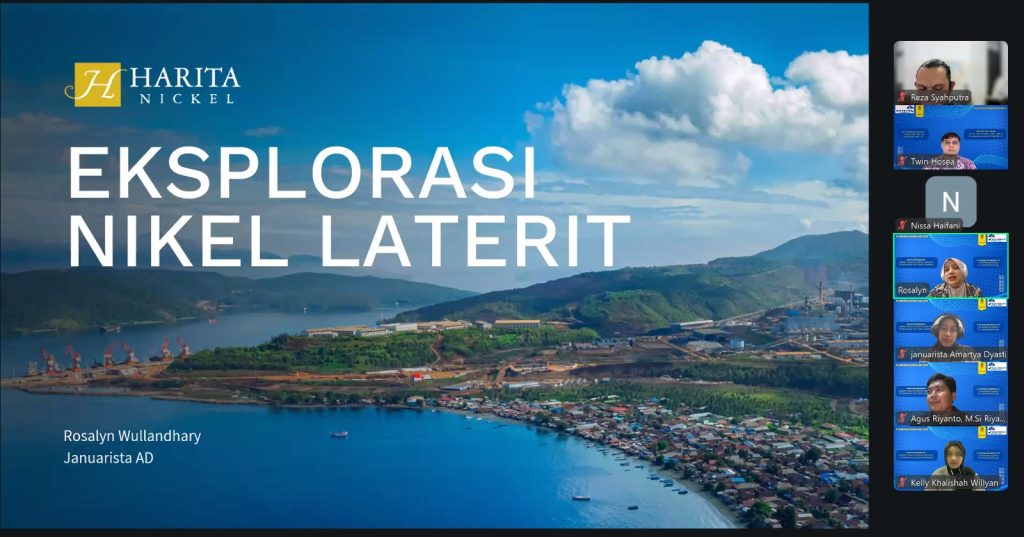
Depok, September 8, 2026 — Students from the Geology and Geophysics Study Programs at the Faculty of Mathematics and Natural Sciences, Universitas Indonesia (FMIPA UI), explored the stages of nickel exploration through geological modeling during the Universitas Indonesia Geoscience Seminar x STARBORN MENGAJAR 2026. The seminar, themed “Nickel Exploration Journey: From Exploration Activities to Preliminary Geological Modeling,” was held online via Zoom on Monday (September 7, 2026).
The seminar featured two practitioners from PT Harita Nickel Group, namely Indarto Ir. Rosalyn Wulandari, S.T., Ore Modelling Expertise, and Januarista Amartya Dyasti, Resource Geology Specialist. Both speakers provided an overview of the application of geological and geophysical knowledge in exploration activities and mineral resource management.
Rosalyn explained the use of nickel for various industrial applications, including stainless steel and battery materials. She also discussed the characteristics of nickel laterite deposits, which are widely found in Indonesia and formed through chemical weathering and supergene enrichment of ultramafic rocks.
“The characteristics of the deposits serve as the basis for geologists to develop a reliable geological model,” said Rosalyn.
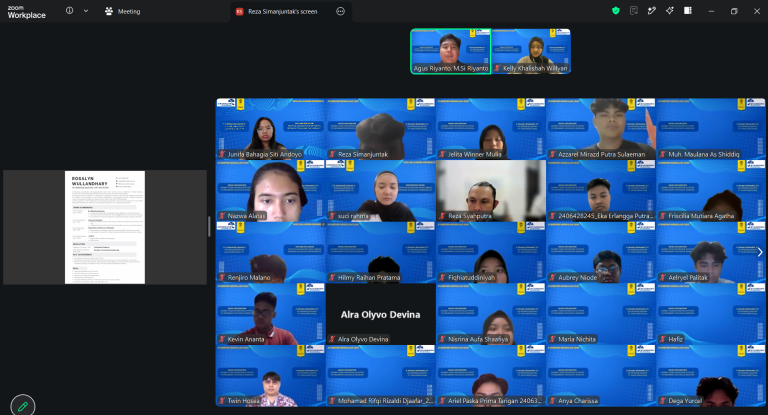
Meanwhile, Januarista discussed the stages of exploration sample preparation, starting with weighing wet samples, followed by drying, crushing, mixing, and splitting/reduction to produce a homogeneous pulp or fine powder.
During these stages, the application of Quality Assurance & Quality Control (QAQC) is necessary to ensure the quality of exploration data. Duplicate samples are used to assess precision, standards to assess accuracy, and blanks to detect potential contamination during the sample preparation process.
Data quality is one of the key aspects to consider before the data is used for three-dimensional geological modeling and resource estimation. Validation is carried out on various exploration data, including collar data, topographic data, survey results, and laboratory assay results.
“QAQC ensures that exploration data is suitable for use as the basis for geological modeling and resource estimation,” said Januarista.
During the seminar, students were also introduced to the integrated operations of PT Harita Nickel on Obi Island, covering the entire process from exploration and mining to nickel processing using High Pressure Acid Leach (HPAL) and Rotary Kiln Electric Furnace (RKEF) technologies.
Environmental management aspects were also discussed, including post-mining reclamation, mangrove planting, and the reuse of nickel slag as a construction material.
During the discussion session, participants asked about how to handle standard sample assay results that fall outside the tolerance limits, such as results exceeding three standard deviations. Januarista explained that a sample batch with results outside these limits cannot yet be accepted and requires further investigation to determine the cause.
According to him, precise but inaccurate results may be related to the calibration of laboratory instruments. Meanwhile, results that are neither precise nor consistent may indicate that the sample homogenization process was not optimal. Once the source of the problem has been identified, the exploration team can conduct a re-assay of the affected batch.
The seminar also provided an overview of the competencies required in the mineral exploration industry. In addition to understanding geological and geophysical concepts, students need to be able to process and validate data, use modeling software, and communicate with various stakeholders.
Through this activity, students from the Geology and Geophysics Study Programs at FMIPA UI are expected to gain a more comprehensive understanding of the connection between academic learning and exploration practices, from data collection and quality control to mineral resource modeling.