
|
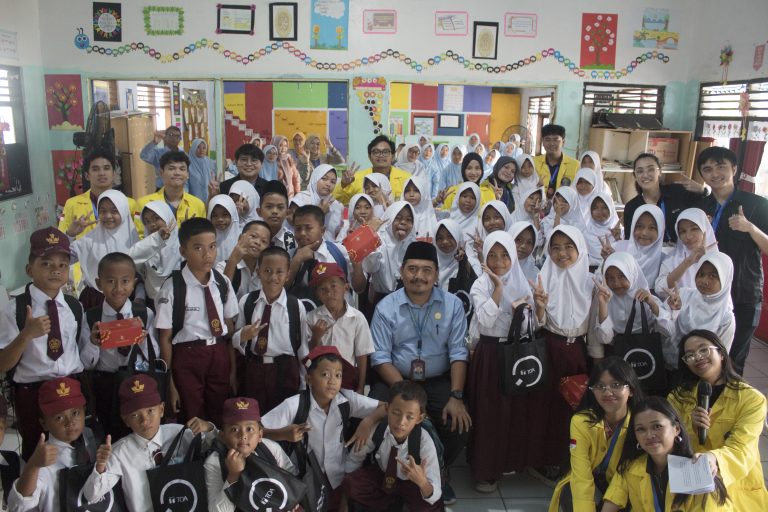
Depok, August 11, 2026 — The academic community of the Faculty of Mathematics and Natural Sciences, Universitas Indonesia (FMIPA UI), helped strengthen disaster preparedness in the school environment through the "Siaga Sejak Dini" (Prepared from an Early Age) Community Service program at SDN 1 Pasauran, Umbul Tanjung Village, Cinangka District, Serang Regency, Banten.
This program, a collaboration between University of Indonesia (UI) faculty members and students from various faculties and PT TOA Indonesia, integrates three approaches: the development of evacuation routes, the production of safety induction videos, and disaster mitigation education through the CREDO (Creative Hazard Education) curriculum. These approaches are designed to equip the school community with both the knowledge and skills needed to handle emergency situations.
SDN 1 Pasauran was selected because it is located in the coastal area of Cinangka District, which faces potential threats from earthquakes and tsunamis resulting from tectonic activity in the Sunda Strait. This situation makes strengthening the capacity of students and teachers essential for fostering a culture of risk awareness from an early age.
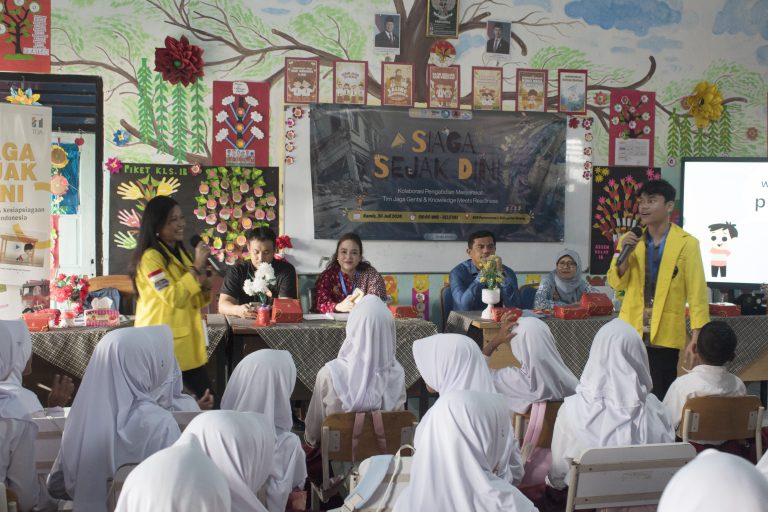
The role of FMIPA UI in this program is reinforced through the involvement of lecturers and students, spanning from the design phase to the implementation of activities. The student community service team, comprising ten students from various faculties at UI, is coordinated by Enjel Toding Rongko’, a student from the Geology Study Program at FMIPA UI.
A team of students mapped evacuation routes, installed signage, and produced a safety induction video containing guidelines for self-rescue during earthquakes and tsunami threats. The video is suitable for ongoing use, including during student orientations and disaster preparedness drills.
“Evacuation routes and safety inductions are crucial components, as knowledge about disasters must be translated into actionable steps for the school community,” said Enjel.
Meanwhile, a faculty team dedicated to community service—led by Twin Hosea W. Kristyanto and Dr. Isnaini Rahmawati from the Faculty of Mathematics and Natural Sciences (FMIPA) at UI—is strengthening the educational aspect through the CREDO (Creative Hazard Education) curriculum.

The curriculum incorporates disaster education through games, discussions, and simple practical activities tailored to the students' age. The material covers an introduction to earthquakes and tsunamis, as well as the necessary actions to take before, during, and after a disaster.
According to Twin, preparedness cannot be sufficiently established merely by providing early warning systems. The knowledge and skills of the school community must be cultivated through continuous training so that they can be applied during emergencies.
“Schools are among the environments that must maintain a high level of disaster preparedness. Therefore, we have developed an approach that integrates education, infrastructure provision, and simulations to ensure that the entire school community possesses the knowledge, skills, and confidence to handle emergency situations,” said Twin.

The series of activities began with a field survey on June 17, 2026. A team comprising lecturers, students, and representatives from PT TOA Indonesia assessed the school's layout to determine evacuation routes, assembly points, and locations for installing the Early Warning System (EWS).
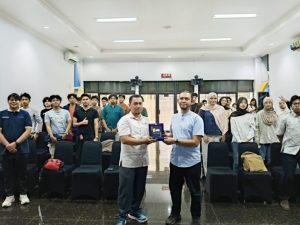
On July 13, 2026, the team installed evacuation route signs and completed the production of a safety induction video. The highlight of the activities took place on July 30, 2026, with the handover of an Early Warning System (EWS) package from PT TOA Indonesia to SDN 1 Pasauran.
In addition to serving as a means of issuing emergency warnings, the system can be utilized as a school audio system to support learning activities and the dissemination of daily information.
Following the handover of the EWS, students participated in earthquake mitigation education via CREDO, followed by an evacuation drill conducted by the Serang Regency Regional Disaster Management Agency (BPBD). When the EWS alarm sounded, students and teachers practiced the drop, cover, and hold on procedure and then proceeded along evacuation routes to the designated assembly point.

The simulation also served as a practical test of the school community's readiness to operate the early warning system, follow evacuation routes, and apply the mitigation knowledge they had been taught.
This program directly benefits 40 students and 22 teachers at SDN 1 Pasauran. The school now has improved evacuation routes and signage, a safety induction video, and an Early Warning System (EWS) that can be utilized on a sustainable basis.
The Principal of SDN 1 Pasauran, Gungun Guntara, S.Pd., appreciates the collaboration. According to him, the program provides benefits not only in the form of facilities but also through knowledge that can be applied by teachers and students.
“This assistance comes not only in the form of facilities but also as knowledge that is highly beneficial for teachers and students. We hope that a culture of disaster preparedness can be consistently practiced in schools so that the entire school community is better prepared to face emergency situations,” said Gungun.

Strengthening school preparedness is highly relevant for Indonesia, given its high risk of geological disasters. For schools in coastal areas facing active tectonic zones, disaster readiness must be established before an emergency occurs—encompassing everything from the ability to recognize risks to executing evacuations swiftly and correctly.
The involvement of FMIPA UI in this program demonstrates how scientific knowledge can be translated into practical solutions for the community. Expertise in geology and disaster management is applied through the mapping of evacuation routes, the development of educational materials, and the strengthening of the school community's capacity.
This program also highlights the importance of collaboration among universities, the government, the business sector, and the community in building disaster preparedness. The initiative is supported through a collaboration between the University of Indonesia’s Directorate of Community Engagement and Social Innovation (DPMIS) and PT TOA Indonesia, involving the Serang Regency Regional Disaster Management Agency (BPBD), the Cinangka District Government, and SDN 1 Pasauran.
Through the “Siaga Sejak Dini” (Early Preparedness) initiative, the FMIPA UI community employs a science-based approach that goes beyond mere knowledge; it translates insights into practical evacuation routes, safety induction materials designed for repeated learning, and the CREDO framework, which fosters preparedness skills starting at school age.