
|
Depok, October 6, 2026 — The Faculty of Mathematics and Natural Sciences, Universitas Indonesia (FMIPA UI), brought industry perspectives into geoscience education through the Universitas Indonesia Geoscience Seminar (UIGS) x Starborn Mengajar 2026, organized by the Geology and Geophysics Study Programs at FMIPA UI. Under the theme “Best Practice Exploration in Mineral Industry”, the seminar explored the mineral exploration process, from understanding geological conditions to cost planning for identifying economically viable mineral deposits.
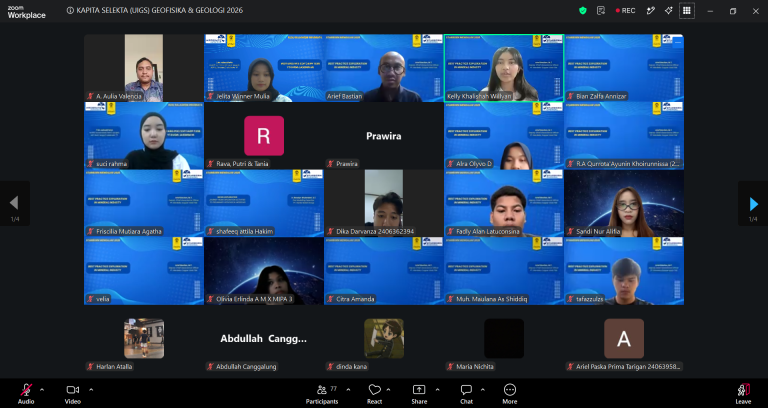
The seminar was held online via Zoom Meeting on Monday, October 5, 2026, featuring Arief Bastian, M.T., Deputy Chief Geoscience Officer at PT Merdeka Copper Gold Tbk., as the speaker. The session was moderated by Ayunda Aulia Valencia, S.T., M.T.
Arief holds bachelor's and master's degrees in Geological Engineering from Institut Teknologi Bandung (ITB) and has more than 19 years of experience in the exploration and development of gold, copper, and nickel mineral resources across Asia. He also has extensive experience managing large-scale exploration programs and conducting Mineral Resource Estimation (MRE) in accordance with the JORC, NI 43-101, and KCMI standards.
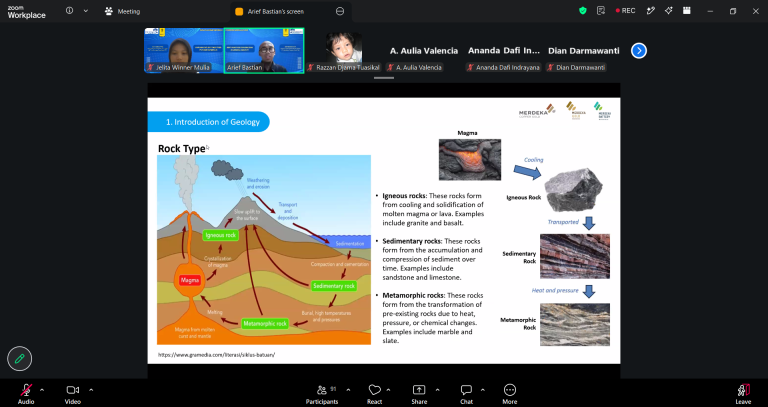
In his presentation, Arief began with the fundamentals of geology, including the principle “The present is the key to the past”, the geological time scale, and the theory of plate tectonics. He then discussed the rock cycle and the three main rock types—igneous, sedimentary, and metamorphic rocks—as a foundation for understanding how mineral deposits form.
One of the deposit-forming processes discussed was the hydrothermal system. Arief explained that hot fluids can interact with surrounding rocks, causing changes known as rock alteration. This phenomenon can be compared to active hydrothermal systems found in volcanic craters.
He also presented conceptual models of porphyry and epithermal deposits. These models illustrate the relationship between subduction zones, porphyry magma intrusions, and the formation of gold and copper (Cu-Au) mineralization under varying temperature and pressure conditions.
Turning to nickel, Arief invited participants to explore the geological processes occurring in the southeastern arm of Sulawesi through the example of the SCM Nickel Project. He explained how obduction processes and accretionary complexes contribute to the emplacement of ophiolites, leading to the formation of a lateritic nickel weathering profile consisting of ferricrete, limonit, saprolit, saprock, and batuan dasar (bedrock).
“Understanding the geological context is essential before determining how exploration should be carried out,” Arief explained during his presentation.
The discussion then moved to mineral exploration methods and stages. According to Arief, three main approaches should be undertaken before exploration begins: geological mapping, geophysical surveys, and geochemical sampling.
“To identify exploration targets, several approaches need to be integrated. Geological mapping helps identify lithology, alteration, and structures, while geophysical methods, such as magnetic surveys, resistivity, and chargeability, measurements, provide insights into subsurface conditions. These findings are then complemented by geochemical data from soil, rock, or stream sediment samples. Together, these datasets help narrow down the search area and identify the most prospective targets,” Arief explained.
From a financial perspective, Arief explained that exploration expenditure is planned to minimize risk, with pemboran (drilling) representing one of the largest cost components. By way of illustration, discovering a gold deposit containing 2 million ounces (2 Moz) could require exploration expenditure of approximately US$20–US$50 per ounce, equivalent to around US$40 million–US$100 million, with 100–250 kilometers of drilling carried out over three to five years.
Exploration is conducted in stages, beginning with Early Exploration over one year, followed by Advanced Exploration over another year, and Resource Definition over two to three years. This sequence aims to increase confidence in the mineral resource, progressing from the Inferred category toward the Measured & Indicated.
For FMIPA UI students, the seminar provided an overview of how geoscience knowledge acquired in the classroom is applied in practical mineral exploration. Geological understanding, the use of exploration technologies, and financial planning are interconnected factors that contribute to exploration success. Through this seminar, students gained insight into the fact that transforming geological potential into economically valuable mineral resources requires not only scientific knowledge but also the ability to analyze data, select appropriate exploration strategies, and consider both technical and economic aspects.